


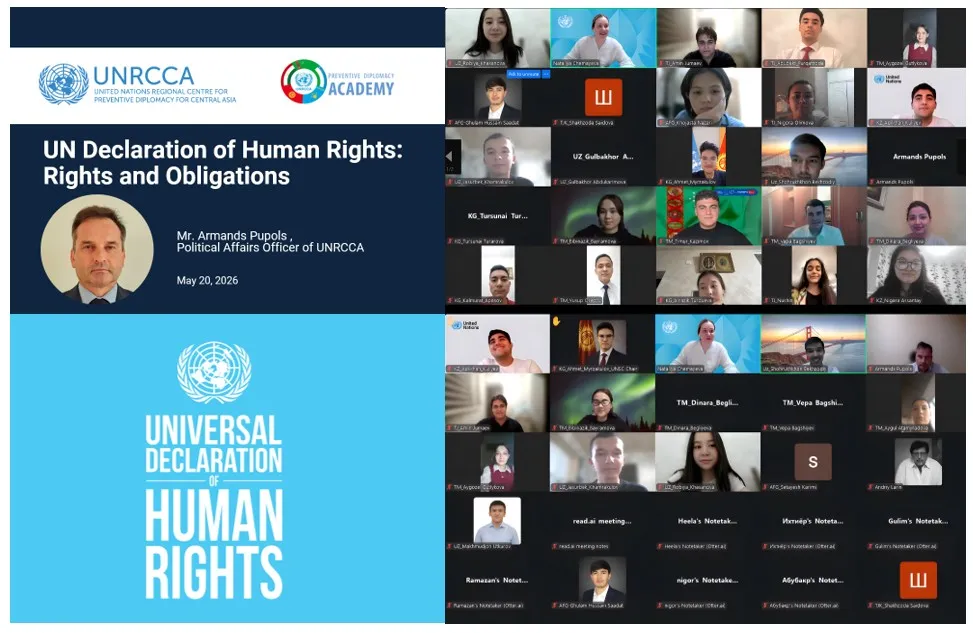
Rights and responsibilities stood at the center of a dynamic online session of the Preventive Diplomacy Academy, convened by the UNRCCA, bringing together emerging leaders from Central Asia and Afghanistan to examine the practical meaning of the Universal Declaration of Human Rights (UDHR).
Framed as both a foundation and a living instrument, the 1948 Declaration guided discussions on how universal principles translate into everyday governance, diplomacy and civic engagement. Led by Mr. Armands Pupols, Human Rights and Political Affairs Officer of UNRCCA, the session connected historical evolution with contemporary challenges, highlighting the role of States in respecting, protecting and fulfilling human rights, while underscoring individual responsibility in upholding them.
Participants engaged in scenario-based exchanges and case reflections, including on Afghanistan, exploring how dialogue, humanitarian engagement and calibrated diplomacy can support human rights in complex contexts. Conversations also addressed the limits and potential of international mechanisms such as the Human Rights Council and the Universal Periodic Review, emphasizing their value as platforms for accountability and cooperation despite political constraints.
A recurring theme was balance: between universality and cultural context, rights and duties, and principle and practice. Participants stressed that safeguarding core rights must remain non-negotiable, while implementation strategies can benefit from cultural awareness and inclusive approaches.
“We are confident that such discussions contribute to building a more just and secure world, where the rights of every individual are respected and protected,” said Mr. Armands Pupols. “Strengthening awareness among young people is key to advancing human rights and preventing conflict.”
The session reaffirmed the role of preventive diplomacy as a bridge between norms and action, equipping participants with analytical tools, dialogue skills and a deeper appreciation of human rights as integral to peace, security and sustainable development in Central Asia.


